Albania
 Bosnia and Herzegovina
 Bulgaria
 Croatia
 Cyprus
 Czech Republic
 Denmark
 Estonia
 Germany
 Hungary
 Italy
Italy
 Kosovo
 Lithuania
 Latvia
 Luxembourg
 Macedonia
 Montenegro
 Poland
 Portugal
 Romania
 Serbia
 Slovaki
 Slovenia
 Spain
Spain
 Switzerland
 Sweden
 Turkey
 United Kingdom
 UAE
UAE
 Hong Kong
 Kuwait
 Lebanon
 South Africa





A comphrensive summary of the information around infant and newborn car seats.
Welcoming a new baby into the world brings a wave of intense joy, along with a seemingly endless list of decisions to make. Long before your due date arrives, you will find yourself researching everything from nursery furniture to the best baby formula. However, out of all the items you will prepare for your little one, few carry as much practical weight as your very first newborn car seats.
For many parents, the first journey home from the hospital is one of the most nerve-wracking drives of their lives. You find yourself driving well below the speed limit, hyper-aware of every turning, bump, and fellow motorist on the road. Having absolute confidence that your child is protected by the highest possible safety features provides immeasurable peace of mind during this monumental transition.
At Smart Cells, we are dedicated to supporting families through the incredible journey of early parenting. While our core expertise lies in preserving your baby’s precious stem cells at birth, we want to help you navigate every aspect of preparing for your new arrival.
It is important to note that our team members are not certified car seat safety technicians or trained specialists in vehicle child restraints. The world of car seat safety can feel overwhelming, with conflicting advice found across online forums and social media. Our goal with this guide is to act as a helpful signpost, breaking down complex regulations into simple, effective advice, and directing you toward official UK guidelines and testing bodies so that you can make fully informed choices for your growing family.
Understanding UK Car Seat Regulations
When you begin looking at the best infant car seats available on the UK market, you will quickly encounter a complex web of product specifications, safety ratings, and legal requirements. To make matters more confusing, if you research child car seats online, you will often find articles referencing organisations from other countries. For instance, you might read about the National Highway Traffic Safety Administration or the Insurance Institute for Highway Safety, both of which oversee road and highway safety in the United States. While their extensive research and rigorous crash testing data rates are incredibly valuable on a global scale, their specific regulations and installation standards do not apply to UK roads. In the UK, we follow strict United Nations regulations that dictate exactly how a child restraint must be manufactured, tested, and fitted.
Historically, the UK has operated under two parallel safety standards for child car seats. The older standard, known as ECE R44, categorises seats primarily based on a child’s weight. Under this weight-based system, seats are divided into specific groups, such as Group 0 for babies up to 10kg, and Group 0+ for infants up to 13kg. While seats meeting the R44 standard are still entirely legal to use if you already own one, the manufacturing and sale of new R44 seats has been phased out in the UK and Europe.
The current, much stricter safety standard is UN R129, often referred to as i-Size when looking at universal vehicle compatibility. The R129 standard was introduced to address several gaps in the older weight requirements system, making it much easier for parents to choose and fit the safest car seat for their child.
The most significant shift under the R129 standard is the transition from weight groups to a strict height limit system. Instead of tracking your baby’s weight in kilograms to determine if they have outgrown their seat, you simply measure their height in centimetres, much like you would check the sizing for their sleepsuits. This change was implemented because parents generally have a much clearer understanding of their child’s height than their exact weight between routine health visitor appointments. Furthermore, height is a far more accurate indicator of how a child’s head and neck align with the protective shell and head support of the seat.
Another critical element of the R129 regulation is the mandatory use of a rear-facing car seat for a significantly longer period. Under the older R44 rules, parents were legally permitted to turn their child into a forward-facing position from around 9kg, which often equates to roughly nine months of age. Medical and crash protection research has conclusively shown that a baby’s neck muscles and skeletal structure are nowhere near developed enough at nine months to withstand the intense crash forces of a frontal collision when facing forward. The R129 legislation makes a rear-facing position legally compulsory until your child is at least 15 months old and has reached a minimum height of 76cm. Many safety experts strongly advise keeping your child in a rear-facing position far beyond this legal minimum, ideally until they are four years old, as this orientation offers the absolute best protection for the delicate brain, spine, and neck.
Deciding on the Right Style for Your Newborn
As you explore the various types of car seats suitable from birth, you will generally find yourself choosing between two distinct styles of newborn car seats. Each option has its own unique design benefits and practical considerations, depending entirely on your family’s lifestyle, budget, and whether you live in a rural area or are city dwellers relying on varied transport methods.

Dedicated Infant Carriers
The first and most traditional option is a dedicated infant carrier, sometimes referred to as a bucket seat. These are lightweight infant car seat options specifically designed to accommodate babies from birth up to a certain height limit, which is typically around 75cm to 85cm, or roughly 12 to 15 months of age.
The primary advantage of an infant carrier is its everyday convenience. These seats feature a prominent carry handle, allowing you to use the seat as a removable carrier. This means you can comfortably strap your baby securely into the seat inside the warmth of your home before carrying them out to the car. It also means that if your baby falls asleep during a journey, you can lift the entire carrier out of the vehicle without disturbing their rest.
Most modern infant carriers are designed to form part of a travel system. This means the seat can be clipped directly onto the chassis of your pushchair, either directly or by using an extra adapter. For parents who slip in and out of shops or have a quick school run with older siblings, the ability to move the seat from the car to the stroller frame without waking a sleeping newborn is an excellent choice.
Convertible and All-in-One Car Seats
The second option available to new parents is a convertible car seat or an all-in-one car seat. These multi-stage seats are engineered to grow with your child from the day they are born until they no longer require a child restraint at all. A convertible seat typically begins its life in a rear-facing mode with specialized newborn inserts to provide proper head support and body alignment. As your child grows past the infancy stage, the seat can be adjusted, the inserts removed, and eventually rotated to become one of the forward-facing car seats that your toddler will use for several years.
Some of these advanced models even transition into booster seats or a high-backed booster car seat for older children, offering a single investment that spans a decade of use. The clear benefit of this style is long-term cost efficiency, as you avoid the need to purchase a next car seat when your baby outgrows their first carrier.
However, there are significant trade-offs to consider with an all-in-one model. Unlike an infant carrier, a convertible car seat is a significantly heavier seat that is designed to be semi-permanently installed in the back seat of your vehicle. It cannot be used as a removable carrier, it lacks stroller compatibility, and you cannot carry it into the house with your baby inside. If you frequently swap your child restraint between different cars, the weight and permanent install method of a large multi-stage seat can introduce considerable installation friction.
While many of these all-in-one car seats claim to be suitable for newborns, car seat experts argue that they’re not the safest option as they’re trying to do too many jobs. Parents also find that, in practice, a car seat designed to last a lifetime often doesn’t make it that far, thanks to the somewhat messy nature of children! It’s important that a car seat doesn’t pass its expiration date (more on this below), and there’s just a certain amount of wear and tear that comes with using a car seat every single day which might put it out of action before your child is old enough to be out of a car seat. In this case, if you’re buying multiple car seats throughout your child’s life, you might as well buy ones that are most suitable for each stage of life rather than a one size fits all (/most) option.
360 Rotating Car Seats
In recent years, rotating car seats have become exceptionally popular among new parents, and it is easy to see why. A 360 spin seat allows you to turn the car seat towards the open car door, meaning you can face your baby fully while buckling them in or lifting them out.
Instead of twisting your spine and leaning awkwardly into the back seat while lifting a growing baby, you can stand comfortably outside the vehicle. This minor design shift offers incredible everyday convenience and significantly reduces physical strain on your back during those early postpartum months.
Crucially, spinning seats also make it much easier to verify that the harness is fitted flat and tight without any hidden twists. Once your baby is safely buckled, you spin the seat back into the rear-facing position until it clicks firmly into place. Many of these rotating options function as convertible seats, meaning they stay fixed on an ISOFIX base in the car and transition from rear-facing use to a forward-facing setup when your child reaches the legal age and height requirements.
Evaluating Essential Safety and Comfort Features
When conducting your own extensive research into different car seat models, you’ll find a wide array of terminology used to describe the various safety features and comfort features built into modern seats. Understanding what these features actually do will help you cut through the marketing language and focus on what truly matters for your child’s safety.
Crash Testing and Real-World Protection
Every car seat sold legally in the UK must pass basic regulatory crash testing to achieve its approval sticker. However, many premium brands subject their seats to independent consumer crash tests that are far tougher than the legal minimums. Organisations such as ADAC in Germany run independent test results that score seats on severe frontal and side-impact collisions at higher speeds than standard government tests. When looking at these independent crash tests, you can gain a much clearer picture of how a seat manages crash forces in real-world scenarios.
One of the major advancements introduced by the R129 standard is mandatory side-impact testing. In a side-impact collision, there is very little vehicle crumple zone between the colliding car and your baby in the back seat. Therefore, the seat itself must feature advanced energy-absorbing materials within its side shells to shield your baby’s head and chest. Many premium models feature additional pop-out side elements that are deployed on the side of the seat closest to the car door, acting as an early crumple zone to absorb impact forces before they reach the main shell of the seat.
Managing Rebound and Stability
When a vehicle is involved in an impact, the car seat experiences an initial forward or rearward force, followed immediately by a secondary movement in the opposite direction as the seat bounces back. To manage this secondary movement in a rear-facing car seat, manufacturers utilise specific stability features.
Many infant carrier bases and convertible seats are equipped with integrated anti-rebound bars. This is a metal bar or reinforced panel that presses firmly against the backrest of the vehicle’s rear seat. In the event of a crash, the anti-rebound bar prevents the child car seat from rotating or flipping upwards toward the back window, keeping the seat stable and securely in place.
Another common stability feature found on premium R129 bases is a load leg base. A load leg is an adjustable metal pole that extends downwards from the front of the infant car seat base and rests firmly on the floor of your car. The primary job of a load leg is to absorb a significant portion of the downward crash forces during a frontal impact, preventing the car seat from pivoting forward and reducing the forward movement of your baby’s head and neck. If you choose a seat with a load leg, it is vital to check your vehicle’s manual, as some cars feature hidden under-floor storage compartments in the rear footwells. A load leg must never be placed on top of a hollow storage compartment lid, as the intense forces of a crash could cause the lid to break, rendering the support leg useless.
Interior Features and Harness Systems
On the inside of the seat, your baby is held secure by a harness system.. The five point harness system consists of two straps over the shoulders, two across the hips, and one between the legs, all meeting at a central buckle. This configuration ensures that if an impact occurs, the forces are distributed across the strongest bony parts of your baby’s body rather than their soft abdomen.
When adjusting the seat as your baby grows, look for models that feature a no-rethread harness. In older version models of car seats, adjusting the height of the shoulder straps required you to completely unthread the harness straps from the back of the seat and thread them back through a higher set of slots. This process can be tedious, and it introduces the risk of twisting the straps or reinstalling them incorrectly. A seat with a integrated headrest and harness adjustment allows you to change the height of both elements simultaneously with a simple pull of a lever at the back, ensuring the straps are always at the perfect position relative to your baby’s shoulders.
For everyday convenience, minor details can make a significant difference. Features like magnetic buckle holders are small magnets built into the fabric sides of the seat that hold the harness straps open and out of the way while you are lowering your newborn into the carrier. This prevents you from accidentally sitting your baby on top of the straps, making the daily routine of getting in and out of the vehicle much smoother. Some have a magnet in the buckle itself which helps snap the two pieces together more easily before inserting them into the buckle – this can be especially handy for little ones who like to wriggle when getting in the car seat!
Mastering the Installation Method
Even the absolute safest car seat on the market will fail to protect your child if it is not installed correctly. Incorrect installation is one of the most common issues identified by road safety charities during voluntary car seat checking days. When choosing a seat, you must carefully consider the install method that best fits your specific vehicle and personal needs.
The ISOFIX System
The ISOFIX system was developed to standardise how child car seats are attached to vehicles, specifically designed to eliminate the common mistakes associated with using adult seat belts for installation. This system relies on anchor points built directly into the chassis of the car, which are usually found tucked into the gap between the base and the backrest of the rear seats.
When installing an i-Size seat or a compatible infant carrier base, you extend the rigid latch mechanisms from the base and push them firmly into the vehicle’s anchor points until you hear a clear click. Most modern ISOFIX bases feature visual indicators, such as green tabs or electronic lights and sound alerts, that change colour only when the rigid latch is perfectly locked into place and the load leg is correctly tensioned against the floor. This clear feedback provides immense reassurance to parents, ensuring a high level of ease of use and minimising installation errors.
Seat Belt Installations
While ISOFIX is incredibly popular and widely used, installing a seat using the vehicle’s adult seat belt remains a highly safe and versatile option. This method is particularly useful if you frequently use older vehicles, family member’s cars, or licensed taxis that might not have ISOFIX anchor points available.
When installing an infant carrier with a seat belt without its companion base, it is referred to as a baseless infant car seat installation. This method requires you to feed the vehicle’s lap belt across the lap guides on the top of the carrier, and wrap the diagonal shoulder belt around the back of the seat through a specific rear guide.
Many high-quality infant carriers utilise what is known as a European belt path. In a European belt path system, the diagonal shoulder portion of the adult seat belt wraps entirely around the back of the infant carrier shell. This specific routing helps to anchor the top of the seat more securely against the vehicle seat, significantly reducing the forward rotation and tilting of the carrier in a collision compared to standard belt paths.
No matter which installation method you choose, you must always ensure the seat is pulled tight against the vehicle upholstery with absolutely no slack or wobble. If you are using a seat belt installation, make sure the belt is pulled taut and that the buckle itself is not resting against the plastic frame of the car seat in a way that could cause it to snap open under pressure, a dangerous situation known as buckle crunch.
Your specific car seat will provide the correct installation details for a seat belt, so make sure to follow the manufacturer’s instructions.
Daily Car Seat Use
Once you have selected a seat that meets the latest safety standards and fits perfectly in your vehicle, the focus shifts to how you use that seat on every single journey. Correct daily operation is just as vital for your child’s safety as the built-in engineering of the seat itself.
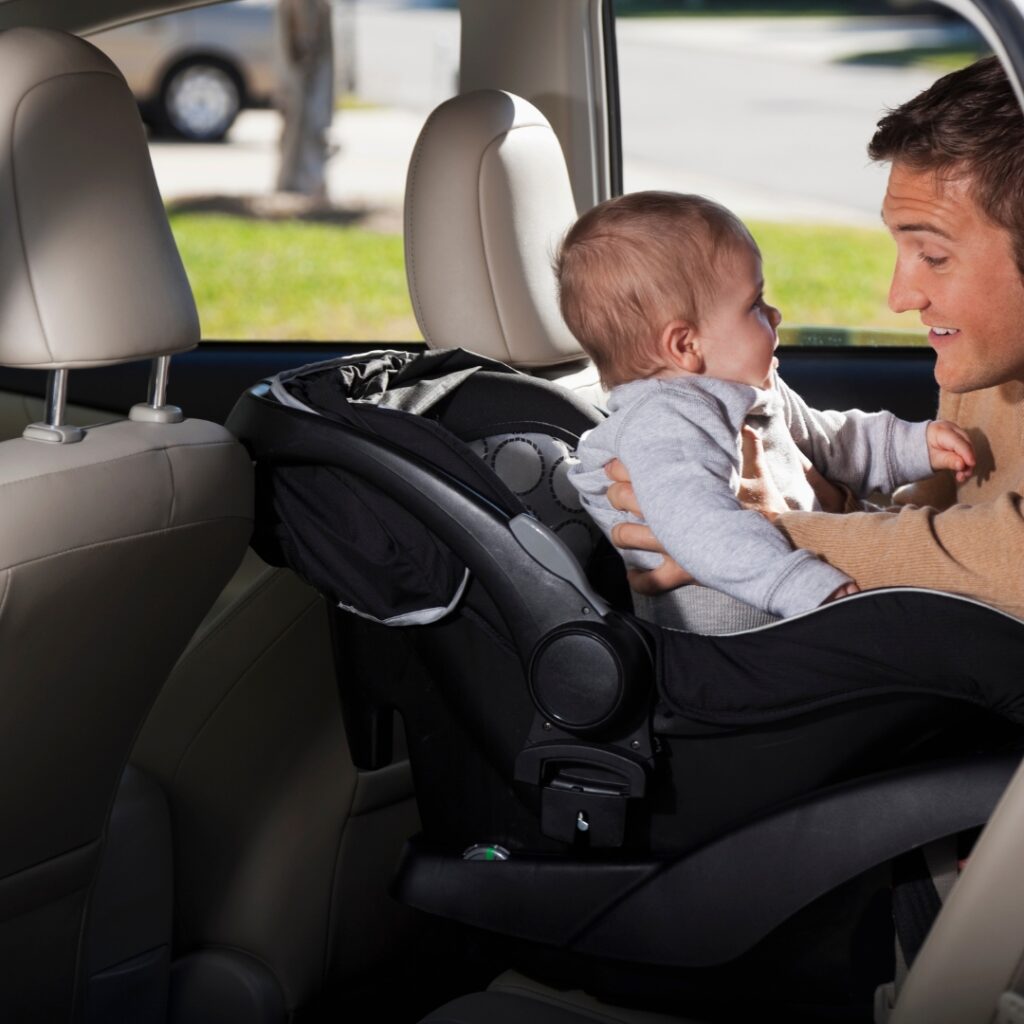
Setting Up the Perfect Fit
When placing your new baby into their seat, pay close attention to the internal cushions. Most infant carriers come equipped with a specialised newborn insert designed to support a tiny baby’s head, neck, and hips. Newborns have relatively large heads and very weak neck muscles, meaning that if they sit too upright, their heavy head can easily flop forward onto their chest, potentially restricting their delicate airway. A proper newborn insert creates a flatter, more reclined surface to keep their airway open and secure. As your baby grows and gains head control, you will need to remove these inserts according to the precise measurements specified in the manufacturer’s instruction manual.
Once your baby is positioned comfortably, it is time to tighten the harness straps. The straps should come out of the seat back shell either level with or slightly below your baby’s shoulders when they are in a rear-facing position. To ensure the harness is tight enough, safety experts recommend using the pinch test. Attempt to pinch the webbing of the harness strap between your thumb and forefinger at the baby’s collarbone. If you can grab any fabric and pinch it into a fold, the harness is too loose and needs to be tightened further. The harness should fit snugly against your baby’s body, allowing only enough space for one or two fingers to fit flat between the strap and their chest.
Thick Clothing & Coats
One of the most frequent mistakes made during the colder months in the UK is placing a baby into their car seat while they are wearing a thick winter coat, snowsuit, or heavy padded cardigan. While it is completely natural to want to keep your new baby warm, padding creates a dangerous illusion of a secure fit.
When you tighten a harness over a bulky coat, the thick material compresses instantly under the immense forces of a vehicle collision. This sudden compression leaves an unexpected amount of slack in the harness straps, creating a gap large enough that your baby could be thrown forward or completely ejected from the seat.
The correct approach is to dress your baby in their normal, thin indoor clothing layers before securing them tightly into the car seat. Once the harness is safely buckled and passed the pinch test, you can tuck a warm blanket over the top of the harness straps, making sure it stays well clear of their face. This keeps them warm and cosy while ensuring the safety features of the harness can function exactly as intended.
The Two-Hour Rule for Newborns
While car seats are designed to protect your baby during travel, safety experts and medical professionals advise against keeping a newborn in a semi-reclined car seat for extended periods. This guideline is widely referred to as the two-hour rule.
Because of a newborn’s developing spine and respiratory system, sitting in a curved position for too long can cause their heart rate and oxygen saturation levels to drop slightly, or cause them to slump forward. It is recommended that a baby should not spend more than two hours in a car seat within any 24-hour window. This rule applies not only to long car journeys but also includes the time your baby spends sleeping in the seat when it is clipped onto a stroller frame as part of a travel system.
If you are planning a long family journey across the UK, ensure you schedule regular, frequent stops. Take your baby completely out of the seat during these breaks, allowing them to lie flat on a blanket, stretch out their limbs, and move around naturally before resuming your trip.
Managing Stroller Compatibility and Everyday Convenience
For many parents, the choice of a first infant car seat is heavily influenced by how well it integrates with their chosen pushchair. The ability to create a seamless transition between driving and walking is a cornerstone of modern parenting convenience.
When researching stroller compatibility, you will discover that many premium car seats are designed to fit a wide range of pushchair brands beyond their own manufacturer. Brands frequently use standardised attachment points, meaning that with the correct set of extra adapters, you can easily combine an infant carrier from one specialist brand with a stroller from another.
Whether you are looking at specific pushchairs like Graco strollers, Joovy strollers, or high-end premium travel systems, you must always consult the official compatibility charts provided by both the car seat manufacturer and the stroller brand. Never attempt to force a car seat onto a stroller frame if it does not click into place with an approved adapter, as a insecure connection poses a severe risk to your child’s safety if the frame encounters a kerb or uneven pavement.
While using your car seat as part of a travel system is incredibly helpful for brief errands, always keep the two-hour rule in mind. For long walks in the park or extended shopping trips, a dedicated lie-flat carrycot attachment for your pushchair is always the healthier and safer environment for a newborn baby, allowing them to sleep flat on their back without any restriction on their developing posture or breathing.
Tracking Expiration Dates and Wear & Tear
Like many items engineered for safety, car seats do not last forever. Every car seat has a definitive lifespan, which is dictated by the natural degradation of the materials used in its construction over time.
Why Car Seats Expire
Many parents are surprised to learn that child restraints have an expiration date and will only last so long! The main shell of a car seat is constructed from heavy-duty moulded plastic, lined with energy-absorbing polystyrene or expanded foam. Over years of use, a car seat is exposed to extreme temperature fluctuations inside a vehicle, swinging from freezing winter nights to intense summer heat under direct sunlight. This constant environmental stress, combined with exposure to UV rays, gradually dries out the plastic and foam, making the internal components brittle and prone to cracking under stress.
Most manufacturers clearly stamp or print the manufacture date or an explicit expiration date onto a white or orange sticker located on the underside or back of the seat shell. As a general rule of thumb, a dedicated infant carrier has a safe usable lifespan of around five to seven years from its date of first use, while multi-stage convertible seats designed for longer use may last up to ten years. If you are planning to keep a car seat for a future sibling, or if you are passed down a seat from a trusted close family member, always locate this date to ensure the seat is still within its safe operating window.
Inspecting for Damage
It is crucial to regularly remove the fabric fabric covers of your car seat to clean away the inevitable crumbs and spills, and to perform a thorough visual inspection of the underlying structure. Look closely for any signs of visible damage, such as stress lines in the plastic, hairline cracks in the foam linings, or fraying along the edges of the harness straps. If you detect any structural imperfections, the seat must be replaced immediately, as even a minor flaw can compromise its ability to provide full crash protection.
Dealing with Accidents and Impact Forces
The most important rule of car seat safety is that any seat involved in a vehicle collision must be replaced, regardless of how minor the incident might seem. Even a low-speed bump in a supermarket car park at 10mph can subject the internal plastic components to significant stress, creating microscopic fractures that are completely invisible to the naked eye.
If that same seat is involved in a subsequent, more severe event of a crash, the weakened structure could fail entirely. Many leading car insurance providers in the UK recognise this risk and will cover the cost of a brand-new replacement car seat as a standard part of your policy after an accident. Never be tempted to buy a second-hand car seat from online marketplaces or boot sales where you cannot guarantee its complete history, as you could unknowingly be placing your new baby in a structurally compromised seat.
Risks of Secondhand Car Seats
Because a newborn car seat represents a significant financial investment, it can be very tempting to look for a secondhand option on online marketplaces, boot sales, or community boards to save money. However, buying a used car seat from an unknown source is one of the biggest safety risks you can take.
When you purchase a secondhand seat from an unknown source, you have no way of knowing its true history. A seat can look completely pristine on the outside while harbouring catastrophic internal damage. If a car seat has ever been involved in a minor collision, or even dropped heavily onto a hard driveway, the structural integrity of the plastic shell or the internal energy-absorbing foam may be severely compromised.
Furthermore, you cannot be certain if the seat has been cleaned incorrectly. Washing the internal harness straps with harsh chemicals, bleach, or submerging them completely in water can degrade the strength of the fabric fibres, making them prone to snapping under the sudden tension of an accident.
Unless you are receiving a seat from a trusted close family member or friend where you know the exact history from the day it was unboxed, it is always best to buy new. If budget is a major concern, it is far safer to buy an affordable, brand-new car seat that meets the latest UN R129 standards than a discounted, premium model secondhand.
Environmental Factors and Interior Health
In recent years, the conversation around child car seats has expanded beyond traditional crash protection to encompass the general health and environmental impact of the materials used inside the vehicle cabin. Babies spend a significant amount of time in close proximity to the fabrics and foams of their car seats, making material safety a growing priority for many expectant parents.
When reviewing premium infant seats, you may notice certifications such as Greenguard Gold or references to lower chemical emissions. A Greenguard Gold certification means that the fabrics, foams, and plastics used to manufacture the seat have been independently tested to ensure they meet some of the world’s most rigorous third-party standards for low chemical emissions. This testing monitors thousands of volatile organic compounds that can off-gas into the air over time. Selecting a seat with these credentials ensures that the air quality immediately surrounding your newborn inside the car is as clean and free from harsh chemical treatments as possible, offering extra reassurance for families mindful of sensitive newborn skin and respiratory health.
Seeking Professional Verification
Navigating the vast market of car seats can feel like an overwhelming task during the hectic third trimester of pregnancy. Popular models from major brands feature unique design highlights and specific benefits, whether you are comparing the sleek integration of an Uppababy Aria V, looking at the innovative safety engineering of a Clek Liing, exploring the lightweight frame of a Nuna Pipa RX, or researching trusted classics like the Chicco Keyfit Max Cleartex and other entries in the Chicco Fit family.
However, no single model can be labeled as the absolute safest car seat for every single family. The best seat for your new baby is one that fits your child’s current height, fits correctly within the specific contours and anchor points of your individual car, and is easy for you to install and operate correctly on every single journey.
Because car seat safety is a highly technical field with life-saving implications, we strongly encourage all expectant parents to seek out professional, hands-on guidance before making a final purchase. Many reputable nursery retailers across the UK employ staff members who have undergone extensive training in child restraint installation. These experts can demonstrate how to fit different seats directly inside your own vehicle, showing you how to manage the seat belt routing or lock the ISOFIX bases securely. Taking the time to visit a specialist store and practice installing a seat under expert supervision is the best way to ensure you feel completely confident and prepared when the time comes to bring your beautiful new baby home for the very first time.
Rate this article: